Fall Commercial Cleaning Checklist for Minnesota Facilities
In Minnesota, pre-winter facility work has a deadline that has nothing to do with your calendar — it ends at the first hard freeze. Exterior rinsing, floor refinishing, gutter clearing, and anything that needs water or dry time all stop being possible once temperatures stay below freezing. This checklist walks through what to finish this fall, in what order, and which items genuinely cannot wait until spring.

Minnesota gives you a window — roughly late September through the first week of November — when pre-winter facility work is still physically possible. After the first hard freeze, half the list becomes a spring project. Hose bibs shut down. Floor finish won't cure in an unheated dock area. The gutters you meant to clear are a solid trough of frozen leaves.
So a fall commercial cleaning checklist for Minnesota buildings is really a sequencing problem, not a task list. None of the individual jobs are complicated. What separates a building that gets through February cleanly is the order the work happened in — and whether the water-dependent items happened at all.
Work through it in this order: exterior and entry zones, floors, air and filters, snow-response documentation, and finally the scope conversation with whoever cleans the building.
Why Fall Is the Only Window You Get
The constraint is physical, not administrative. Exterior rinsing, sealing, strip-and-refinish work, and anything fed by a hose all need above-freezing temperatures and dry time. Once the North Metro settles into sustained sub-freezing weather — usually by mid-November — those jobs are off the table until spring, whatever your budget says.
Skipping them costs nothing in October. It costs you a slip claim in January. Federal injury data put falls, slips, and trips at 479,480 days-away-from-work cases in private industry, a rate of 22.6 per 10,000 full-time workers, with a median of 13 days away. A wet, salted lobby floor is a textbook contributor, and one lost-time claim outweighs the cost of everything on this checklist.
Federal guidance treats this as a maintenance question, not a seasonal nicety: EPA names delayed or insufficient maintenance as a moisture source in its own right, alongside roof leaks and bad drainage.
Start Outside — Entry Zones, Gutters, and the Roof
Size the entry zone before the slush arrives
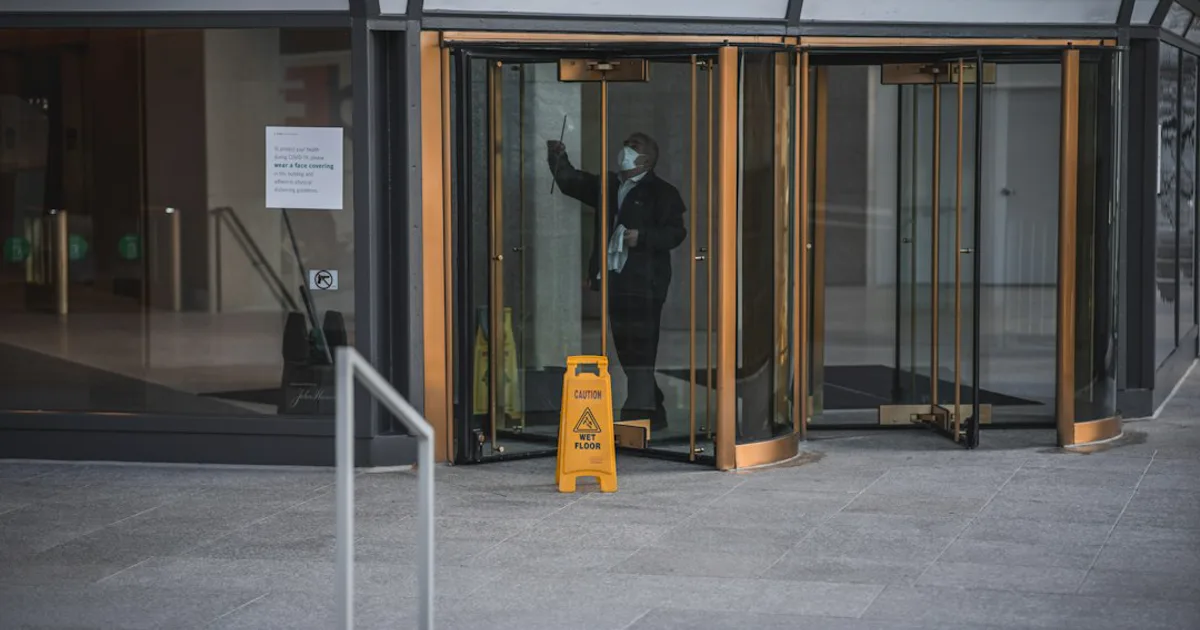
Your summer matting layout won't capture a Minnesota winter's worth of meltwater. Entries need enough walk-off length to dry a shoe before it reaches finished floor, which usually means adding mats for the season. Federal safety guidance is blunt about the catch: floor mats must lay flat rather than wrinkled or bunched, or the mat you installed to prevent a fall becomes the thing that causes one.
Stage the supporting hardware now too — trash cans, umbrella bags, wet-floor signage — where staff can actually reach them at 6 a.m. during the first storm. For mat type and sizing, see our guide to commercial entrance matting in winter.
Deal with water that will freeze where you don't want it
Clear gutters and downspouts while the leaves are still loose. EPA names gutters or landscaping that direct water into or under the building as a primary moisture source, and its core principle is that indoor mold growth is controlled by controlling indoor moisture. Water-damaged materials should be dried promptly — usually within 24 hours.
Inspect roof and flashing before the first snow load sits on them, and confirm drainage carries water away from doorways. A downspout that discharges three feet from an entrance is an ice sheet waiting for the first thaw-freeze cycle.
Finish the exterior hard surfaces
Sweep or rinse walks, docks, and the lot while water still runs. Then mark every hazard that will vanish under six inches of snow — wheel stops, grade changes, drain covers, curb edges.
Do the Heavy Floor Work Before Salt Season
Hard floors need their sacrificial layer now
Strip, refinish, or reseal in the fall so the finish takes the chloride and grit abuse instead of the substrate. Holding a sound finish through winter is routine work; rescuing a worn one in March means shutting down an area during the busiest part of a tenant's year. Scope and downtime vary with floor type and square footage, so get the timeline on the calendar early.
Send carpet into winter clean, not dirty
A deep extraction before the soil load arrives makes winter maintenance upkeep rather than recovery. Salt and sand grind fibers down fastest on already-soiled carpet, so its condition on December 1 largely determines what it looks like in April. For the mid-winter side, see removing salt stains from office carpet.
Service the equipment and stock the consumables
Get autoscrubbers and extractors serviced before they're needed daily. Confirm neutral-pH and salt-neutralizing products are in stock, and that entry-zone consumables won't run out during the first storm week — exactly when nobody has time to order.
Handle Air and Filters Before the Building Seals Up
Once windows stay shut for five months, HVAC is effectively the building's only ventilation. EPA is direct about why that matters: an adequate supply of outside air is necessary in any office environment to dilute pollutants released by equipment, building materials, furnishings, products, and people.
There's a predictable cold-weather tradeoff here. Heating outdoor air is expensive, so some building engineers reduce or eliminate outdoor air during cold spells — which lets contaminated air accumulate and pollutant concentrations rise. A continuous supply of fresh air still has to be provided.
On filters, EPA's guidance is to replace them based on pressure drop across the filter or on a schedule, using properly sized MERV-13 filters or the highest MERV rating the system accommodates. The fall preventive-maintenance list is specific: outdoor air intake, damper controls, filters, drip pans, heating and cooling coils, fan belts, humidification controls, distribution systems, exhaust fans.
One detail ties this back to the first section: dust and dirt get drawn in from outside through the ventilation system and outdoor air intakes. If your intakes sit near walkways that get salted and sanded, that load climbs in winter. Our piece on winter indoor air quality in Minnesota offices covers the dust and vent side in depth.
Build a Snow, Ice, and Slip-Risk Response You Can Document
OSHA's winter weather guidance comes down to speed: clear snow and ice from walking surfaces and spread deicer as quickly as possible after a winter storm. The companion walking-working-surfaces standard, 29 CFR 1910.22, requires surfaces be kept clean, orderly, and sanitary, and floors maintained in a clean and, so far as possible, dry condition. That's the standard a slushy January lobby gets measured against.
Decide the specifics now rather than during a storm: who clears what, by when, and who verifies it. Federal guidance recommends an aggressive program for prompt removal of ice and snow from parking lots, garages, and sidewalks — which only works if responsibilities are assigned before the first event.
Stage labeled bins of ice melt with scoops at heavy pedestrian-traffic points — building entrances, parking-garage entrances and exits — so staff who spot an icy patch can treat it immediately instead of waiting on a contractor. Add a notification channel too, so staff get a heads-up when ice and snow are predicted.
Then put it in writing. Federal guidance recommends a written housekeeping program distributed to all employees, to keep quality and consistency stable. That document does double duty: it's how a winter entry-zone routine survives contact with a 6 a.m. shift in January, and it's your record if a claim is ever filed. None of this eliminates slip risk — it reduces it, and documents reasonable care.
Reset Your Janitorial Scope for Winter Frequency
The cleaning scope that worked in July will under-serve your entry zone in January. Have that conversation in October, while it's still a planning discussion rather than a complaint about a floor that already looks bad.
What usually changes: entry and lobby frequency goes up, matting rotation and laundering get added, salt-neutralizing products get specified by name, a storm-response trigger gets defined, consumables move to a shorter restock cycle. What usually doesn't: interior offices away from the doors, restroom cadence, and periodic work already fixed on an annual calendar.
Write it as a seasonal addendum with explicit start and end months, so the scope reverts on its own in spring instead of quietly becoming the new baseline. If you're reviewing providers for commercial cleaning across the Minneapolis North Metro, ask how they handle seasonal scope changes — the answer says a lot about how they run accounts.
Frequently Asked Questions
When should a Minnesota facility finish its fall cleaning prep?
Work backward from the first hard freeze rather than from a calendar date. Across the Minneapolis North Metro, overnight lows start dipping below freezing in mid-to-late October, and sustained sub-freezing stretches usually arrive by mid-November. Anything involving water, outdoor rinsing, or a floor finish that needs dry time should be done before that window closes — roughly by the first week of November. Filter changes and scope changes can continue later; the exterior items can't.
What is the single highest-return item on a pre-winter facility checklist?
The entry zone. It's where the liability sits, where the soil load that damages your floors enters the building, and where occupants form their impression of the property. Sizing your walk-off matting properly, staging ice melt at the doors, and raising entry-zone cleaning frequency costs far less than one lost-time claim.
Should floors be stripped and refinished in the fall or wait until spring?
Fall, in most cases. A fresh finish applied before salt season gives hard floors a sacrificial layer to take the chloride and grit, and it's easier to maintain a good finish through winter than to rescue a worn one in March. Spring refinishing makes sense only when the floor is already past saving, or when a tenant schedule makes fall shutdown impossible.
How much should winter cleaning frequency change from the rest of the year?
Entry zones and lobbies typically need meaningfully more attention — often daily, or several passes per day in high-traffic buildings — while interior areas away from the doors usually stay on their existing cadence. It depends on door count, foot traffic, parking-lot surface, and whether your snow contractor uses sand. The practical move is a written seasonal addendum spelling out which tasks increase between November and March.
The Bottom Line — Your Pre-Freeze Game Plan
Sequence beats effort. Exterior and water-dependent work goes first because the weather sets that deadline, floors come next, air and documentation follow, and the scope conversation closes it out. The buildings that get through a Minnesota winter cleanly are the ones that made their decisions in October.
If you want a second set of eyes on your pre-winter list, request an estimate.
This article is for general informational purposes only. Cleaning scope, frequency, and pricing vary by facility size, type, and condition. Service availability depends on your location within Neat & Clean Co's service area. Contact us for a quote specific to your facility.
Related articles
Office Deep Cleaning Cost in the Twin Cities: Spring Pricing
Spring deep-clean quotes in the Twin Cities often land 40 percent apart on the same building, and the spread usually comes down to scope and crew hours rather than one bidder being wrong. This guide breaks down what a deep clean actually covers, why Minneapolis-area cleaning labor runs about ten percent above the national mean, the three pricing models facility managers encounter, the five factors that move the number most, and how to normalize competing bids before you sign anything.

Winter Indoor Air Quality in Minnesota Offices: Filters, Vents and Dust
Winter indoor air quality in a Minnesota commercial building comes down to filters, vents and dust. Here is what EPA guidance says and who should handle each task.
Twin Cities Commercial Cleaning Labor Rates: A 2026 Overview
Facility managers comparing janitorial bids keep asking for the going hourly rate in the Twin Cities, and the honest answer is that no single number exists. Federal wage data sets one benchmark, Minnesota and two city ordinances set three different legal floors depending on the job-site address, and a burden stack of taxes, insurance, supervision, and newly required paid break time sits between a cleaner's wage and the figure on your invoice.