Commercial Entrance Matting in Winter: A Minnesota Facility Guide
In a Minnesota winter, the first fifteen feet inside your front door decide whether the rest of the building stays dry, safe, and presentable — and most buildings cover those fifteen feet with three feet of mat. This guide walks through the three-zone matting system, how to size walk-off matting by footsteps rather than by catalog, what construction details matter when chloride and freeze-thaw are involved, and the storm-driven service cadence that keeps matting working from November through April.

The First Fifteen Feet Do Most of the Work
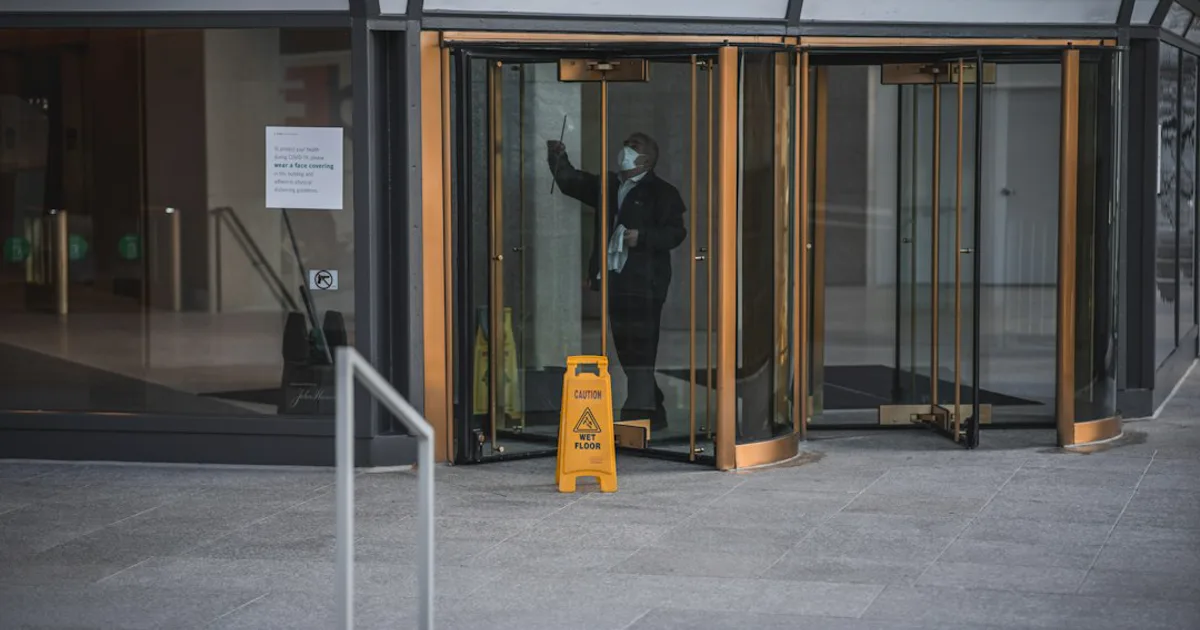
Commercial entrance matting in winter is the lowest-cost facility control most Minnesota buildings underuse. Everything on your lobby floor in January — the slush, the grit, the white chloride bloom creeping out from under the walk-off runner — arrived on the sole of a shoe and passed through the first fifteen feet inside your door. In a lot of North Metro buildings, those fifteen feet are one three-foot mat that went down after Halloween and gets left alone until April.
A thin entry is three problems wearing one coat: a slip-and-fall exposure at the building's busiest pinch point, a floor-finish replacement cost, and unbudgeted labor, because every gallon of snowmelt past the matting becomes mopping and re-burnishing. A bigger mat order won't fix it. What fixes it is treating matting as a designed system — zones, length, construction, and a cadence that moves with the weather.
Why One Mat at the Door Fails a Minnesota Winter
Five months, not five days. That's the exposure window here. The North Metro cycles through freeze and thaw from November into April, and every cycle reloads the sidewalk with slush and the walk-off zone with brine. Which is why NIOSH's guidance isn't simply "use mats" but to add supplemental matting during winter months and rain, on the logic that entrances are where snow and rain get tracked inside. An entry that works in September is underbuilt in January.
Budgeting against the cost side is straightforward. BLS counted 479,480 private-industry cases involving days away from work from falls, slips, and trips in 2024, with same-level falls — the entrance-mat category — running at 14.7 per 10,000 full-time workers and a median of 10 days away per case. Ten median lost days, plus the comp claim, plus the separate premises-liability question when the person who goes down is a visitor. Against that, another twelve feet of matting is a rounding error.
Then there's saturation. A three-foot mat in an active storm absorbs its capacity in the first hour of morning traffic, then stops being a control and becomes a delivery system, handing water to the finished floor behind it.
The Three-Zone Matting System
Zone 1 — scraper, outside the door. Bulk removal: snow clumps, grit, salt granules, slush packed into the tread. The surface is aggressive and open — rubber or coir-style — and the critical requirement is that it drains rather than pools, because a mat holding standing water outside a Minnesota door is a sheet of ice by 6 a.m.
Zone 2 — scraper/wiper, the vestibule. Dual action: it finishes the scraping Zone 1 started and begins absorbing moisture. This is the zone most buildings skip, and it explains why a lobby floor stays damp from December to March.
Zone 3 — wiper/dryer, inside the lobby. High-absorbency nylon or polypropylene, pulling the last film of brine off the sole before it reaches finished floor or carpet. It saturates first, so it needs mid-storm swaps.
Sequence matters more than any single mat. Put a wiper outside and it freezes solid; put a scraper inside and it pushes water forward instead of holding it. One corollary most buildings miss: service doors and loading docks track in more salt per person than the front entrance, because those people crossed the part of the lot that gets the heaviest application — and they routinely get no matting at all.
How Much Matting Your Entrance Actually Needs
Size it in footsteps, not feet. NIOSH's rule is that mats must be large enough that several footsteps fall on the mat, which in a Minnesota winter means roughly 12 to 15 feet of continuous matting across the three zones for a single-leaf entry. Double doors, clinic lobbies, and retail entrances need more, because traffic arrives in bursts and the matting never recovers between them.
That guidance also includes a field test that beats any catalog formula: if you see water on the floor around or beyond the mat, the mat is undersized, saturated, or both. That's a swap or a replacement, not a wet-floor cone.
Two sizing errors show up constantly. First is the center runner — a narrow strip down the middle of a doorway, as though people walk single file through a six-foot opening. Both flanks go unprotected, and the runner's long edges sit in the traffic path waiting to catch a toe; matting should run the full width of the opening. Second is treating length as fixed building-wide: a back door with forty entries a day and a main lobby with four hundred need different programs.
Mat Construction, Backing, and the OSHA Angle
Specification isn't complicated, and most of it comes straight from NIOSH: beveled edges on all four sides, flat and continuous or interlocking construction, slip-resistant backing, and the mat secured against movement. Add one Minnesota requirement — materials that tolerate repeated chloride exposure and hot-water extraction without delaminating. Rubber-backed nylon holds up in the wiper zone; cheap foam backing curls by February.
What disqualifies a mat mid-season matters as much. Curled corners, ripped edges, bunching, and worn pile all put a mat on the replace list. A mat in that condition hasn't stopped working — it has converted a slip exposure into a trip exposure.
The compliance hook sits in OSHA's walking-working surfaces standard, 29 CFR 1910.22, which requires surfaces be kept clean and, to the extent feasible, dry; names mats among accepted provisions where wet conditions exist; and names snow and ice explicitly among hazards surfaces must be kept free of. It also requires regular inspection and prompt correction — which is why a dated winter entry log earns its five minutes a day. We covered what OSHA 1910.22 actually requires separately.
The Winter Matting Maintenance Cadence
Daily. Vacuum or extract the wiper zone, sweep grit off the scraper zone, and check every edge for curl and pooling. Then walk the first twenty feet past the matting and look for the bloom line — the chalky white edge where brine dried on the floor. That line is your diagnostic. Where it sits tells you how far the salt is getting, and if it has crept deeper into the lobby since last week, the matting has stopped doing its job.
During and after a storm. Swap or extract the saturated wiper mat instead of waiting for the next scheduled service. Increase hard-floor passes behind the matting, and use a neutral-pH cleaner rather than a residue-leaving detergent — the wrong chemistry on a salt-contaminated floor leaves a film slicker than what you started with. Resist the temptation to let a cone stand in for the work: NIOSH notes that most slip incidents occur from wet floors or floors contaminated with fluids, and ranks engineering controls above signage.
Weekly through monthly. Deep-extract the wiper matting, inspect backing adhesion, and rotate spares so a soaked mat gets drying time off the floor; mats that go back down damp never recover their absorbency. Carpet behind the matting needs attention on this cadence too — the methods differ in cost and downtime, compared in commercial carpet cleaning methods — and chloride residue behaves differently from ordinary soil, covered in removing salt stains from office carpet.
End of season. Full extraction, backing inspection, and an honest replace-or-keep call before storage. A mat you keep because it looks acceptable in May is one you'll apologize for in December.
Control the Salt Before It Reaches the Door
Most of the salt in your lobby was over-applied outside. EPA's stormwater practices for deicing material application and storage come down to four habits: calibrate spreaders to pavement temperature instead of defaulting to a heavy blanket pass, favor anti-icing before a forecast event over deicing after it, sweep and recover excess granular material once the event ends, and store bulk salt covered on an impervious pad.
Product selection matters too. EPA Safer Choice ice-melt products must cut sodium and chloride use by at least 30 percent against comparable products while still performing below 0°F — a real specification in Minnesota, where plenty of commodity rock-salt blends quit well above the pavement temperature you get in January. Magnesium chloride is gentler but needs twice the volume for the same coverage; calcium chloride runs about three times the cost of rock salt.
This is a floor-care decision, not only a grounds decision. EPA attributes roughly $5 billion in annual U.S. repair costs to deicer corrosion — the same chemistry that hazes floor finish and pits concrete indoors, covered in ice melt damage on commercial floors.
Frequently Asked Questions
How many feet of entrance matting does a commercial building need in winter?
Measure in footsteps, not feet: a pedestrian should take several full strides on matting before touching bare floor. For a single-leaf entry in a Minnesota winter that usually means 12 to 15 feet across all three zones, and double-door entries need more. NIOSH also gives a field test that beats any formula — water around or beyond the mat means it's too short or already saturated.
How often should winter entrance mats be cleaned or swapped?
Vacuum or extract daily through the snow season, and plan a mid-day swap for the wiper zone during active storms, because a saturated mat stops absorbing and starts releasing water onto the floor behind it. Most North Metro facilities run daily service plus storm-driven swaps from December through March, then deep-extract after the last thaw.
Do entrance mats actually reduce slip-and-fall liability?
They help, but only as part of a documented program. OSHA 1910.22 names mats as an accepted control for wet surfaces and requires walking-working surfaces be kept free of hazards including snow and ice. A curled, undersized, or soaked mat can become the hazard itself, so the inspection log matters as much as the mat. Results vary by facility, and this is general information rather than legal advice.
Will ice melt tracked in on mats damage our floors?
Chloride residue is corrosive — EPA attributes roughly $5 billion in annual U.S. repair costs to deicer corrosion, and the same chemistry hazes floor finish and leaves white bloom in carpet. Matting intercepts most of it, but the real fix is upstream: calibrated application rates outside and prompt post-event sweeping.
Your Winter Entry Game Plan
Matting is a system, not a seasonal purchase: three zones with distinct jobs, sized in footsteps rather than by catalog, serviced on a cadence that moves with the storms instead of the calendar.
Three steps before the first real snow: measure the walk-off length at every public and service door, add the vestibule zone you're almost certainly missing, and write the daily and storm-day cadence down so it survives a staffing change. Neat & Clean Co handles winter entry and floor care for commercial cleaning across the Minneapolis North Metro — for a second set of eyes on your entries before December, request an estimate.
This article is for general informational purposes only. Cleaning scope, frequency, and pricing vary by facility size, type, and condition. Service availability depends on your location within Neat & Clean Co's service area. Contact us for a quote specific to your facility.
Related articles
Office Deep Cleaning Cost in the Twin Cities: Spring Pricing
Spring deep-clean quotes in the Twin Cities often land 40 percent apart on the same building, and the spread usually comes down to scope and crew hours rather than one bidder being wrong. This guide breaks down what a deep clean actually covers, why Minneapolis-area cleaning labor runs about ten percent above the national mean, the three pricing models facility managers encounter, the five factors that move the number most, and how to normalize competing bids before you sign anything.

Fall Commercial Cleaning Checklist for Minnesota Facilities
In Minnesota, pre-winter facility work has a deadline that has nothing to do with your calendar — it ends at the first hard freeze. Exterior rinsing, floor refinishing, gutter clearing, and anything that needs water or dry time all stop being possible once temperatures stay below freezing. This checklist walks through what to finish this fall, in what order, and which items genuinely cannot wait until spring.

Winter Indoor Air Quality in Minnesota Offices: Filters, Vents and Dust
Winter indoor air quality in a Minnesota commercial building comes down to filters, vents and dust. Here is what EPA guidance says and who should handle each task.