Warehouse Floor Scrubbing Frequency: How Often Is Enough?
Ask three people how often a warehouse floor should be scrubbed and you'll get three answers, from every shift to whenever it looks bad. Federal standards don't settle it either — they describe a condition, not an interval. Here's what actually sets your frequency: traffic volume, vehicle type, soil load, floor finish, and dock exposure. Plus a four-tier zone model that gives different parts of one building different schedules, baseline ranges by warehouse type, and how to write it into a scope of work.
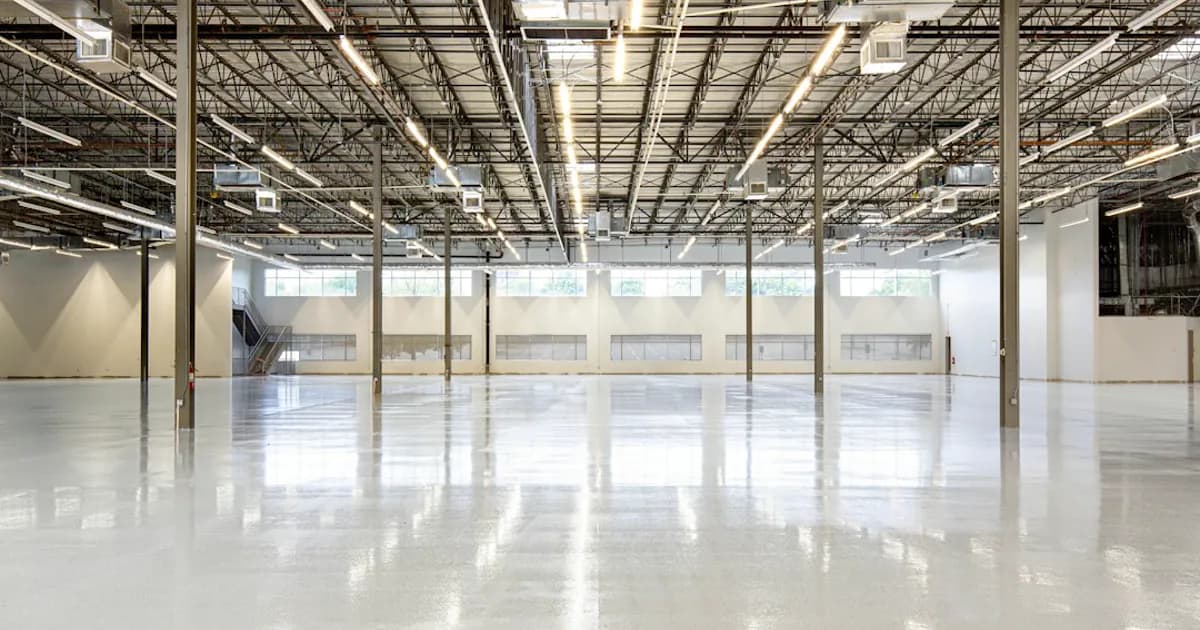
How Often Is Enough?
Ask three people how often a warehouse floor should be scrubbed and you'll get three answers: every shift, once a week, and whenever it starts to look bad. That's a spread wide enough to be useless for budgeting. It's also why warehouse floor scrubbing frequency tends to get set by whoever last complained about the floor, rather than by anything resembling a method.
The question sits where three budgets overlap. It's a safety control. It's a labor line item — often the largest one in an industrial janitorial scope. And it's a floor-life decision, because scrubbing too little and scrubbing too much both shorten the life of a sealed slab, just by different mechanisms.
What the Rules Require — and What They Leave to You
Start with the disappointing part: no federal standard hands you an interval. OSHA's walking-working surfaces rule requires that all places of employment, passageways, storerooms, and walking-working surfaces be kept in a clean, orderly, and sanitary condition, that each workroom floor be maintained clean and, to the extent feasible, dry, and that surfaces stay free of hazards including leaks, spills, snow, and ice. The sanitation standard adds that sweepings and refuse be removed as often as necessary or appropriate to maintain the place of employment in a sanitary condition.
Put those two phrases side by side — "to the extent feasible" and "as often as necessary or appropriate" — and the regulatory posture comes into focus. These are performance standards. They name the outcome and leave you the schedule, which means your required frequency is whatever actually produces that outcome with your traffic and your product.
During an inspection, that distinction matters. An inspector evaluates the floor in front of them, not the calendar on the wall. What a documented, zone-based schedule gives you is evidence that a program exists and gets followed. The materials-handling standard carries a related obligation: storage areas must stay free of accumulations that create tripping, fire, explosion, or pest-harborage hazards — which is why under-rack and perimeter floor can't be deferred indefinitely just because nobody walks there. For the full breakdown, see what OSHA 1910.22 actually covers in a warehouse.
Why Frequency Is a Safety Number
Falls, slips, and trips aren't a minor category. Federal injury data put them at 479,480 days-away-from-work cases in private industry, a rate of 22.6 per 10,000 full-time-equivalent workers, with a median of 13 days away — against a median of 8 days across all injury events. Translated: the injuries tied most directly to floor condition keep people out roughly 60 percent longer than the average recordable incident. The sector data holds the same shape. In private transportation and warehousing, falls on the same level accounted for 10,940 recordable cases in a single year out of 206,900 total.
A warehouse also carries a factor that offices don't. A film of tire rubber, hydraulic residue, and bonded dust isn't only a pedestrian slip risk — it's a stopping-distance problem for a loaded forklift, and OSHA lists both hazard types among warehousing's serious hazards. Run the math against your own incident history. One lost-time slip at a 13-day median absence, plus the claim and the backfill, frequently costs more than a year of incremental scrubbing.
Six Variables That Set Your Real Frequency
- Traffic volume and shift count. Forklift and foot passes per aisle per day is the strongest single predictor. A two-shift pick module and a one-shift overflow bay shouldn't share a frequency.
- Vehicle type and tire compound. Cushion and solid tires leave markedly more black marking than pneumatics, and an electric fleet adds charging-area water and acid exposure.
- Product and soil load. Palletized dry goods in stretch wrap shed almost nothing. Bagged material, bulk powders, lumber, auto parts, and food distribution each load the floor differently and call for a different pad and chemical.
- Floor type and finish. Coated floors show marks sooner but release them more easily. Porous bare concrete does the opposite — it hides soil and absorbs it, so the floor that looks acceptable longer is often the one accumulating more.
- Dock and entry exposure. In Minnesota that means a five-month season of salt, sand, and slush with a cadence of its own, plus a chemical-damage risk layered on top of the soil — see our guide to ice melt tracked in from the dock apron.
- What the floor is for. A floor customers walk, auditors photograph, or food-safety inspection covers carries an appearance standard above the safety minimum.
A Traffic-Tiered Schedule for One Building
Here's the single most useful change most facilities can make: stop asking how often to scrub the warehouse, and start asking how often to scrub each part of it. Public-health cleaning guidance takes the same risk-based approach — high-traffic areas get cleaned more frequently, other surfaces when they're visibly dirty. Lay that logic over a floor plan and you get tiers.
- Tier 1 — daily or every shift: dock aprons and door thresholds, main drive aisles, receiving and staging floors, marked pedestrian walkways.
- Tier 2 — two to three times weekly: secondary aisles, pick-module cross aisles, battery charging areas, shipping lanes beyond the dock apron.
- Tier 3 — weekly: perimeter aisles, accessible under-rack floor, maintenance and tool areas.
- Tier 4 — monthly or quarterly: overflow and reserve storage bays, seldom-entered mezzanine floor, anything needing a rack move to reach.
Build the map on foot, with a printed floor plan, marking the forklift and pedestrian lanes that actually exist rather than the ones the original layout intended. Put the zones that need a rack move on the calendar as dated projects, because a nightly crew will never reach them otherwise. Then reassess seasonally — a Minnesota dock apron in January is not the zone it was in August.
Baseline Frequencies by Warehouse Type
Starting points to adjust from, not standards:
- High-throughput distribution and e-commerce fulfillment (multi-shift): Tier 1 daily to once per shift; full-floor pass weekly.
- Mid-volume regional distribution (one to two shifts): main aisles and dock two to three times weekly; full floor weekly to biweekly.
- Cold storage and food distribution: main lanes daily, with freezer and cooler thresholds attended to more often for ice and condensation. Sanitation requirements often drive this schedule more than traffic does.
- Light assembly and light industrial: production aisles daily to two or three times weekly depending on process residue; full floor weekly.
- Low-turn storage and 3PL overflow: aisles weekly; full floor monthly.
The adjustment signal is how the floor looks at the midpoint between passes — not the morning after one. If the midpoint looks fine, you have room to stretch the interval. If it doesn't, you don't. That same test travels across building types; our overview of cleaning frequency by facility type applies it to offices, retail, and medical space.
Spills and Inspections Are a Separate Job
A scrubbing schedule doesn't satisfy your inspection obligation. The walking-working surfaces rule requires that surfaces be inspected regularly and that hazardous conditions be corrected before an employee uses the surface again — guarded in the meantime, if the correction can't be immediate. A floor scrubbed every Tuesday is not a safe floor on Thursday when a pallet of detergent splits open. The structure is straightforward: a per-shift visual walk of Tier 1 zones, spill kits staged at the dock and charging areas rather than a central closet, and cones within reach of whoever finds the hazard — not just the cleaning crew.
Signs Your Frequency Is Wrong
Too infrequent: black tire marking that no longer lifts in one pass; a gray haze that makes the floor look dirty the day after scrubbing; a visible soil line where last week's scrubber path ended; near-miss reports clustering at the same aisle intersections.
Too frequent, or wrong method: coating dulling ahead of its expected recoat cycle; pad consumption out of proportion to the square footage cleaned; crew time spent in Tier 4 zones that show no soil at all. In most buildings the fix is re-tiering, not a global increase or decrease.
Turning the Schedule Into a Scope of Work
A frequency decision that lives in someone's head won't survive a staffing change. Put it in writing: the zone map with tier assignments, frequency per zone, method per zone (sweep, scrub, burnish, recoat), equipment and pad spec, the shift window, who inspects, and how exceptions get logged. Measure it on a defined inspection route with scored results rather than a general impression — the approach covered in how a janitorial service level agreement gets measured and written into your scope of work. Budget the periodic work that rides alongside the scrub cycle too: deep scrub and restoration, recoat or reseal on coated floors, and dust control on racking. Neat & Clean Co builds zone-based floor programs as part of warehouse and industrial cleaning across the Minneapolis North Metro.
Frequently Asked Questions
How often should a warehouse floor be scrubbed?
High-throughput distribution floors with multi-shift forklift traffic usually need main aisles and dock aprons scrubbed daily or every shift. Mid-volume facilities typically scrub main lanes two to three times weekly, with a weekly full-floor pass. Low-turn storage buildings often do fine on a weekly aisle pass and a monthly full scrub.
Does OSHA require a specific warehouse floor cleaning schedule?
No. The rules require that surfaces be kept clean, orderly, and sanitary, that floors be maintained clean and, to the extent feasible, dry, and that waste be removed as often as necessary or appropriate. They specify the condition you have to hold, not the interval — so an inspector looks at your floor rather than your schedule, though a documented schedule is good evidence that a program exists.
Is sweeping enough, or do I need an auto-scrubber?
Sweeping removes loose debris, which covers the tripping and housekeeping side of the obligation. What it doesn't remove is the thin film of tire rubber, hydraulic residue, and bonded dust that builds on a slab and cuts traction. That film needs water, chemical, and mechanical agitation. Most warehouses need both: sweeping between scrubs, and scrubbing on a defined cycle.
Can you scrub a warehouse floor too often?
Yes. On coated floors, over-aggressive pads and excessive chemical wear the finish faster than traffic would, which pulls the recoat cycle forward. And on any floor, scrubbing a low-traffic zone at main-aisle frequency is labor with no safety or appearance return. Matching frequency to each zone's soil load usually means scrubbing some areas more often and others less.
The Bottom Line
The standards set a condition, not a calendar, and your scrubbing frequency is whatever holds that condition in your building. It almost never resolves to one number — it resolves to four or five numbers assigned to four or five zones, reviewed seasonally, and written into a scope someone owns. Build the zone map, start from the baselines above, and let each zone's condition at the midpoint between passes tell you where to tighten and where to stretch. If you'd rather have that assessment done with you, request an estimate and we'll walk the floor together.
This article is for general informational purposes only. Cleaning scope, frequency, and pricing vary by facility size, type, and condition. Service availability depends on your location within Neat & Clean Co's service area. Contact us for a quote specific to your facility.
Related articles
Food-Grade Warehouse Cleaning Standards and Audit Preparation
A food-grade warehouse can look immaculate and still fail an audit, because auditors grade the system behind the cleaning rather than the shine on the floor. This guide walks through the two regulatory rulebooks that apply to food storage facilities, how to zone a building by contamination risk, why water is a hazard in dry storage, what EPA label directions actually require of your sanitizer, and which records an auditor opens first. Written for facility and operations managers preparing for a third-party or customer audit.
OSHA Housekeeping Standard 1910.22 Explained for Warehouses
Most warehouse managers file 1910.22 under general tidiness. It is a performance standard with a named hazard list and an inspection-and-repair clause attached, and it applies to every aisle, dock, and mezzanine in the building. Here is what each paragraph requires, how those requirements read on a working warehouse floor, where snow and spills complicate things in Minnesota, and how to set a cleaning cadence you can defend.
OSHA Warehouse Housekeeping Requirements: What 1910.22 Covers
OSHA's housekeeping rule for walking-working surfaces is short. Here is what 1910.22 requires of a warehouse, where 1910.176 takes over for aisles and storage, and where routine cleaning fits.