Commercial Floor Care Programs: Daily, Interim, and Restorative Work Explained
Most buildings do not have a floor care problem — they have a floor care schedule problem. Floors look acceptable for eight months and then suddenly look like they need replacing. A commercial floor care program is simply three tiers of work — daily, interim, and restorative — assigned to each floor surface at a defined frequency. This guide explains what each tier covers, how traffic and floor type set the intervals, where slip resistance and documentation fit, what the program costs, and how to scope it into a janitorial contract.
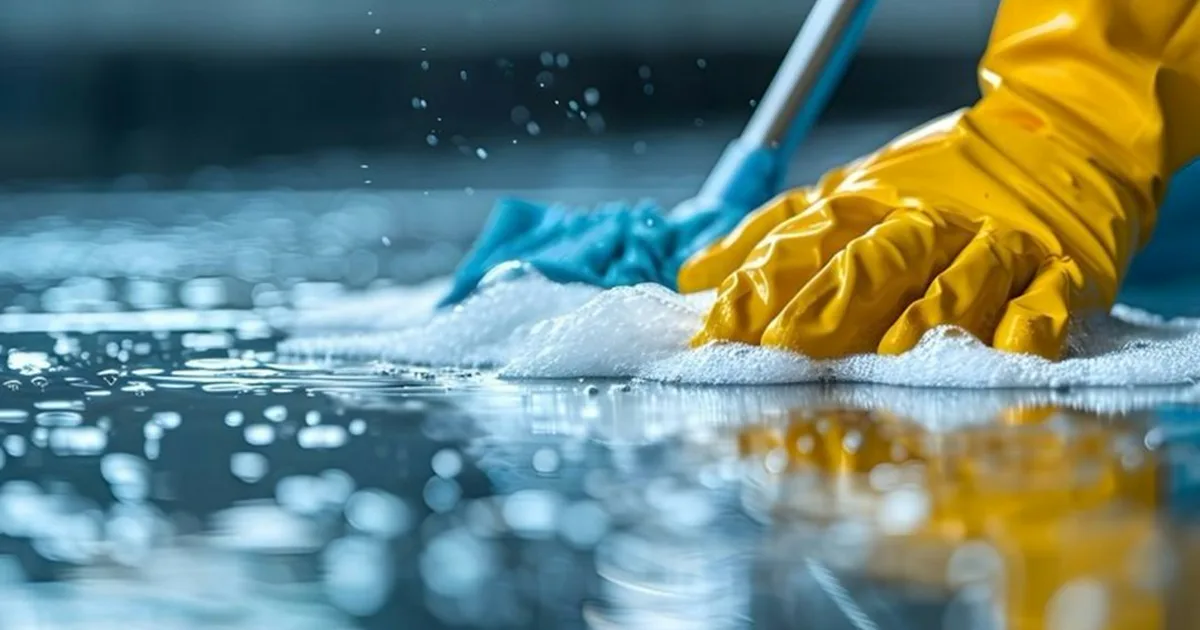
Floors are the largest cleanable surface in most commercial buildings, the first thing a visitor reads as "well maintained," and a documented liability exposure. They are also the surface most facilities manage by reaction rather than by schedule. Which is why a floor looks acceptable for eight months and then, seemingly overnight, looks like it needs replacing.
It rarely happened overnight. The frequent, low-cost work got thinned out, the expensive work got deferred, and the floor eventually forced the issue. A commercial floor care program prevents that: three tiers — daily, interim, and restorative — assigned to each floor surface at a defined frequency.
What Daily, Interim, and Restorative Floor Care Actually Mean
What separates the tiers is what each one does to the floor's protective layer — not how hard the crew works.
Daily care stops soil from accumulating or bonding: dust mopping, damp mopping or auto-scrubbing, vacuuming, spot response, matting. Lowest cost per visit, highest frequency. Interim care brings appearance back mid-cycle without removing the protective layer — burnishing or spray buffing on hard floors, encapsulation or bonnet cleaning on carpet, weekly to quarterly depending on traffic. Restorative care is the full reset: strip the old finish off a hard floor and rebuild it, or deep-extract carpet back to a baseline. It's the most labor-intensive tier, and the only one that puts an area out of service for hours.
Why the sequence matters more than any single tier
The tiers compound, and only in one direction. Thin out daily work and interim work arrives sooner; skip interim work and restorative work arrives sooner. Cutting the daily tier doesn't reduce total spend — it relocates spend into the tier with the highest cost per square foot and the only real downtime. That logic holds for hard surface and soft surface alike. The methods differ completely; the structure doesn't.
Daily Floor Care: The Tier That Decides Everything Else
On hard floors, sequence is everything: dry soil removal first, then moisture. Damp mopping over grit grinds it into the finish and creates the fine scratching that dulls a floor long before the finish actually wears through. So dust mop first. Then damp mop or auto-scrub with neutral chemistry, handle spills as they happen, and manage dry time with signage. Carpet works the same way on a different schedule — vacuum traffic lanes every day, rotate through full areas weekly. Carpet vacuumed only on the lanes everyone can see holds soil in the open areas, where it quietly abrades fiber.
Entry zones do more work than any other control
Most of the soil in a building walks in through the front door, and the lowest-cost place to stop it is the first fifteen to twenty feet of walk-off matting. In this climate that isn't a seasonal nicety — entrance matting in a Minnesota winter carries meltwater, sand, and ice-melt chloride, all of which attack finish and fiber. Matting is also a regulatory item. Where wet processes are involved, federal housekeeping rules require drainage plus dry standing places such as platforms and mats to the extent feasible.
Chemistry is a daily decision with long-term consequences
Neutral cleaners preserve floor finish. High-alkaline chemistry degrades it, which shortens the interval to the next restorative cycle and quietly moves money from the monthly rate into a project quote. EPA's criteria for greener cleaning products include a pH between 4 and 9.5 — closer to neutral, which lines up with what protects a finished floor anyway. Two things worth auditing: over-concentrated cleaner leaves residue that dulls appearance and can affect traction, and a mop bucket nobody changes just redeposits soil.
Interim Floor Care: Getting Appearance Back Without a Full Reset
Both common hard-floor interim methods work the existing finish rather than removing it. Burnishing runs a high-speed machine with a soft pad over a dry floor, heating and polishing the finish back to gloss; spray buffing adds a light chemical mist and a pad to fill in micro-scratching. Both are fast and inexpensive, and neither requires emptying a building. The heavier option is a scrub and recoat — machine-scrub off the top layer, then apply one or two fresh coats. One detail that gets skipped: burnishing throws finish dust onto every horizontal surface nearby, so post-burnish dusting is part of the job.
Carpet interim work is the tier most buildings skip entirely
Low-moisture methods let an area return to service in hours instead of overnight, which is exactly why they belong in a program for occupied space. Encapsulation applies a polymer that crystallizes around soil so the next vacuum pass removes it; bonnet cleaning uses an absorbent pad on a rotary machine. We cover how extraction, encapsulation, and bonnet cleaning compare separately. Skip this tier and carpet goes straight from "new" to "needs replacing," because soil that is never interrupted becomes abrasion.
The decision rule for either surface: interim work is the right call while the protective layer is intact. Once it's gone, interim passes stop producing a result.
Restorative Floor Care: Strip, Recoat, and Deep Extraction
A strip and recoat removes all old finish with stripping solution and an aggressive pad, neutralizes and rinses, then rebuilds two to five coats with dry time between each — a half-day to full-night job per area. It belongs off-hours for a reason beyond equipment noise. EPA notes that during and for several hours after stripping-type activity, indoor VOC levels may be 1,000 times background outdoor levels, with increased ventilation and label precautions as the recommended controls. That argues for an empty building and a ventilation plan, not just a Saturday.
Hot-water extraction is the carpet equivalent: it resets the baseline, needs real dry time, and gets scheduled rather than squeezed in. One budget note — daily and interim work usually sit inside the monthly rate while restorative cycles are quoted per project. Get that split in writing before the first strip and recoat arrives as an unexpected invoice.
Slip Resistance, Documentation, and the Compliance Side
The regulatory baseline is 29 CFR 1910.22, which requires that walking-working surfaces be kept clean, orderly, and sanitary; that floors be maintained clean and, to the extent feasible, dry; that surfaces stay free of hazards including spills, snow, and ice; and that they be inspected regularly and corrected before use. We cover what 1910.22 means for warehouse housekeeping in more depth.
Slip resistance is a floor care variable, not just a flooring-specification variable. OSHA has cited a static coefficient of friction of 0.5 as a guide for proper slip resistance, with a higher value appropriate where workers carry, push, or pull objects. Finish buildup, wrong dilution, poor rinsing — all of it affects traction, which makes the daily tier a safety control and not only an appearance one. And write the program down. OSHA's housekeeping guidance recommends a written program precisely because documentation is what produces consistency across crews.
What a Floor Care Program Costs and How to Scope It
Labor is the cost driver, and the labor market is why documentation matters. BLS reports median pay for janitors and building cleaners of $17.71 per hour as of May 2025, with roughly 321,800 openings projected annually against 2 percent employment growth — turnover, not expansion, sets the hiring pressure. A program carried in a tenured crew's habits degrades as that crew turns over, which makes documentation a cost control rather than paperwork.
Building the frequency matrix
Three inputs set each interval: traffic volume, floor type, and area function. Assign frequencies per area, not per building — a private office corridor and a receiving dock don't belong on the same schedule. For the heavy end, see how often warehouse floors actually need scrubbing.
A reasonable starting matrix for an office property: daily dust and damp mopping on hard floors plus lane vacuuming on carpet; burnishing weekly in entries and lobbies, monthly in corridors, quarterly elsewhere; strip and recoat once or twice a year in entries and high-traffic corridors, every one to two years in private office areas. Then adjust from condition, not the calendar.
Putting it in the contract
Specify four things: method per floor type, chemistry and dilution, frequency per area, and who owns restorative cycles. Then tie those frequencies to terms you can measure — our guide to measuring a cleaning contract with an SLA covers how.
Frequently Asked Questions
What is the difference between daily, interim, and restorative floor care?
Daily care keeps soil from accumulating. Interim care restores appearance without removing the floor's protective layer — burnishing or spray buffing on hard floors, encapsulation or bonnet cleaning on carpet. Restorative care is the full reset: stripping and recoating a hard floor, or hot-water extraction on carpet. The tiers are a sequence, not a menu — skipping one pulls the next one forward.
How often should commercial floors be stripped and recoated?
Intervals vary by traffic, floor type, and how well the daily and interim tiers are running. A lightly trafficked office area on VCT may go a year or more between cycles; a high-traffic entry or a corridor that takes winter salt load may need one or two per year. The usable signal is the finish itself, not the calendar. When burnishing no longer brings back gloss and there is visible wear through to the tile, the floor needs a strip and recoat.
Can floor care work happen during business hours?
Daily work usually can, provided wet-floor signage and spill response are handled properly. Interim work often moves after hours because burnishers and carpet equipment are loud and need clear floor space. Restorative work should be off-hours as a rule: stripping carries the highest chemical load in the cycle, and EPA notes it can raise indoor volatile organic compound levels well above background for hours afterward, with increased ventilation as the recommended control.
Should a floor care program be written into the janitorial contract?
Yes, and separately from the general cleaning scope. OSHA's housekeeping guidance recommends a written program because it is what produces consistency across shifts and crews, and a floor program has variables worth putting on paper: method per floor type, chemistry and dilution, frequency per area, and who pays for restorative cycles. That last item is where most disputes start.
Your Floor Care Game Plan
The daily tier controls the total cost of the program. Underfunding it doesn't reduce spend; it moves spend into the most disruptive tier and shortens the life of the floor underneath. The next step is unglamorous: walk the building, inventory floor surfaces by area and traffic level, assign daily, interim, and restorative frequencies to each, and put that matrix into the contract where it can be measured.
Neat & Clean Co provides janitorial and floor care services for commercial properties across the Minneapolis North Metro. See where we work on our commercial janitorial service areas page, or request an estimate for your facility.
This article is for general informational purposes only. Cleaning scope, frequency, and pricing vary by facility size, type, and condition. Service availability depends on your location within Neat & Clean Co's service area. Contact us for a quote specific to your facility.
Related articles

Day Porter Duties Checklist for Commercial Properties
Day porter service shows up on almost every commercial cleaning proposal, usually as a line item with no definition behind it. Two bids for the same building can differ by twenty hours a week and nobody notices until service starts. This checklist walks through a porter's shift the way it actually runs — opening round, restroom loop, touchpoint round, trash and reset work, and the unscheduled response that fills the rest of the day — then covers how to size the hours and turn the list into contract language.
Cleaning Chemicals in Your Building: What to Ask Your Janitorial Provider
Before a janitorial crew works in your building, ask about the chemicals. Here are the questions on safety data sheets, disinfectants, mixing, ventilation and green claims.
Janitorial Employee Background Checks: What to Ask a Cleaning Company
Cleaning crews often work in your building with keys and codes and few staff around. Here is what to ask a cleaning company about employee screening, what the law asks of them, and how to read the answers.